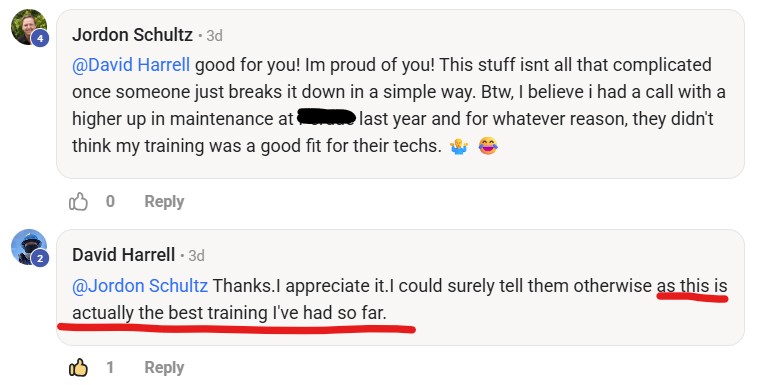
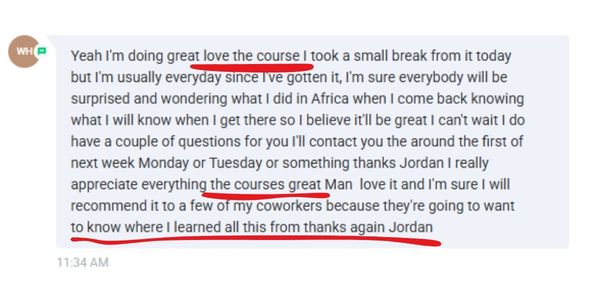
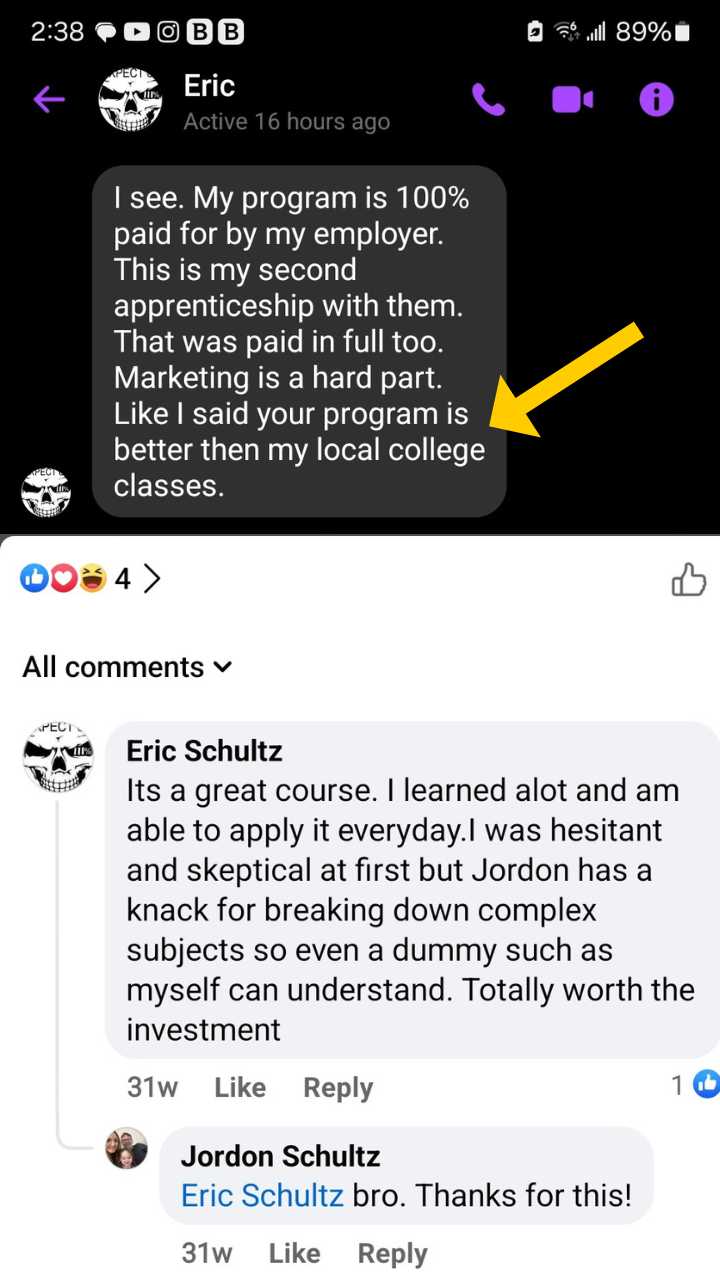
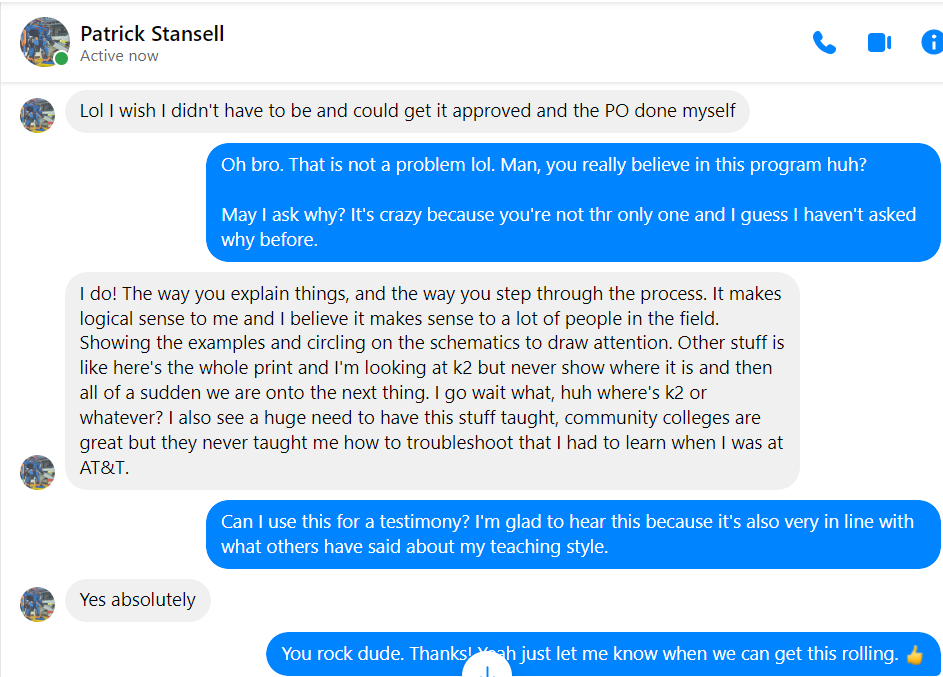
Trusted by 700+ techs at these companies








The techs everyone runs to when the line goes down aren't smarter than you. They just have a process nobody ever taught them. This is that process — the step-by-step way to troubleshoot industrial controls and go straight to the fault.
Trusted by 700+ techs at these companies
You've been in maintenance long enough to know the job. But there are moments — in front of a panel, under pressure, with people watching — where nothing in your background prepared you for what you're staring at. That's not a talent problem. It's a training problem.
You were shown what components do. You were not shown how to think when one fails. There's a profound difference — and nobody in the training system ever bridged it for you.
A fired job. A written warning. A supervisor who said "I thought you knew this." A shift where you couldn't find it and everyone waited. Each one deposits more doubt. More anxiety. More of the knot that shows up every time a machine goes down.
You're a fixer. That's the whole identity. When you can't fix something, it doesn't just feel like a work problem — it feels like a threat to who you are. And when the comparison is to someone who "just gets it," the spiral gets deeper.
"I got called to a machine that was down. I stood there for three hours and couldn't find it. They sent me home. My supervisor said 'I thought you knew how to do this.' I didn't have an answer."
— Industrial Maintenance Tech · Reddit r/IndustrialMaintenanceThis isn't for techs who want to level up. It's for the ones who've been working hard without the one thing that would have made it all make sense.
The maintenance industry doesn't train techs on how to troubleshoot. It throws them at problems and lets trial-and-error be the teacher.
Without a foundational process — reading schematics, using meters, testing components, following a logical fault-finding sequence — every breakdown is a fresh guessing game. Experience accumulates but the process never gets built. Most techs don't realize this is happening until a moment of public failure makes it undeniable.
You don't have to wait for that moment.
Trial-and-error isn't a learning method. It's what fills the gap when nobody teaches you the process.
The longer it runs, the harder the gap is to fill — and the more visible the gap becomes. Most techs spend years in it before they figure out why. The Fault Fixer Troubleshooting Course is built to give you the process before the trap takes hold.
The Fault Fixer Troubleshooting Course is built around the Foundational Four Framework — the four competencies every troubleshooter needs, taught in the sequence that actually builds the skill. Not more information. A structured learning path that produces real confidence.
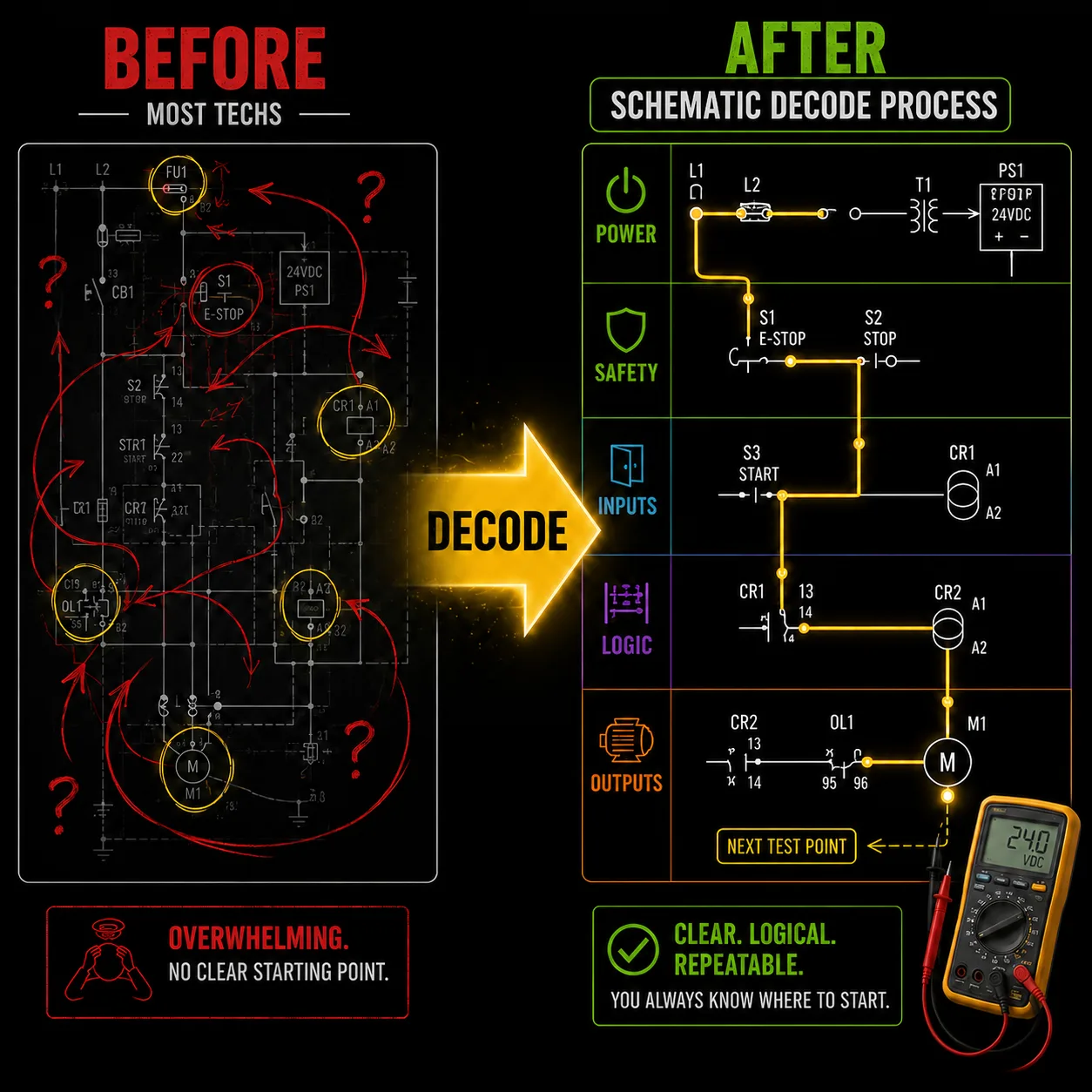
The Schematic Decode Process — a clear, repeatable method for reading any electrical print and tracing any fault path. Works on every schematic you'll ever see.
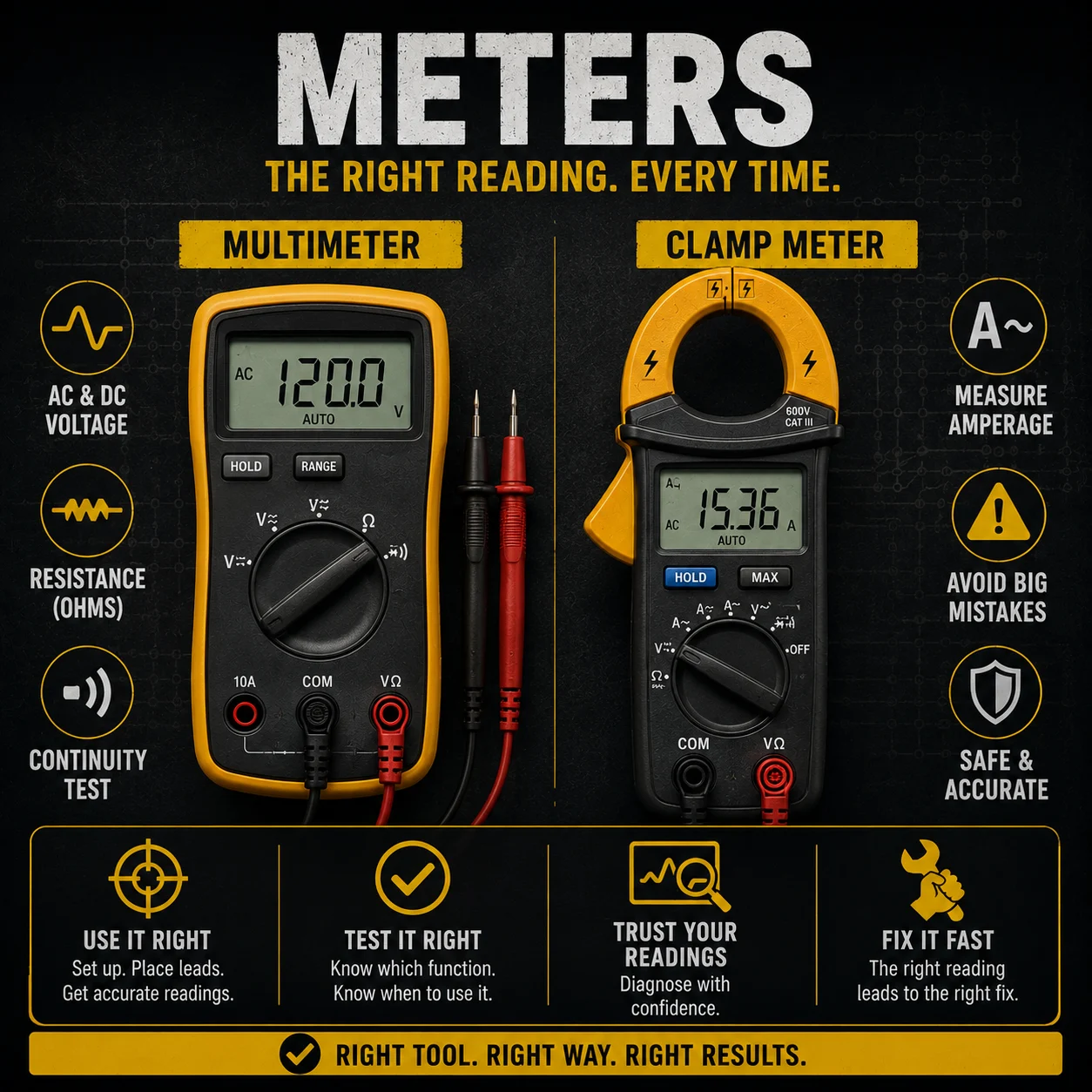
Multimeter and clamp meter precision. What to measure, when, and why — so every test is accurate and every call is sharp. Stop swapping good parts.
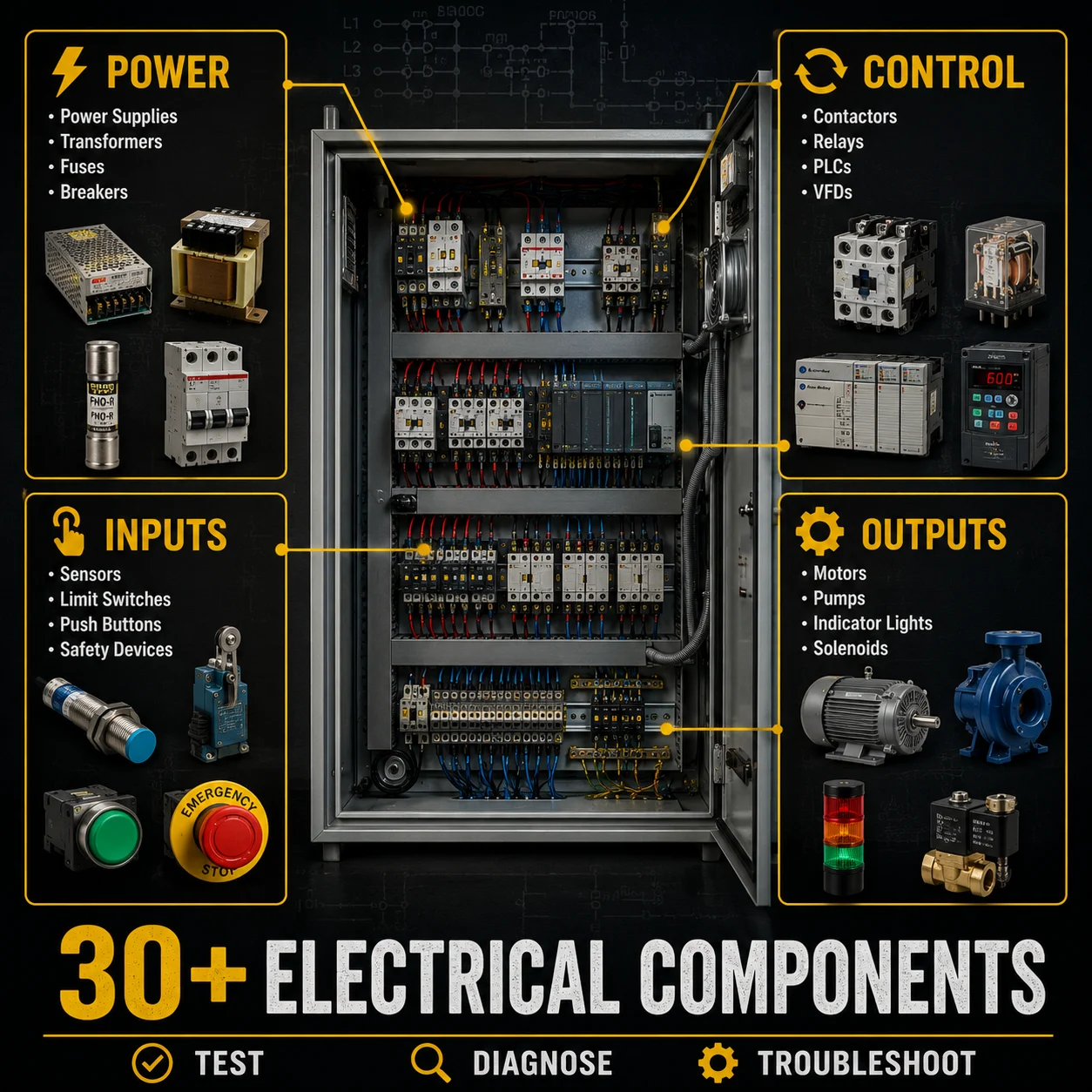
Step-by-step diagnostic guides for 30+ electrical components. What normally takes years on the job, built in months.
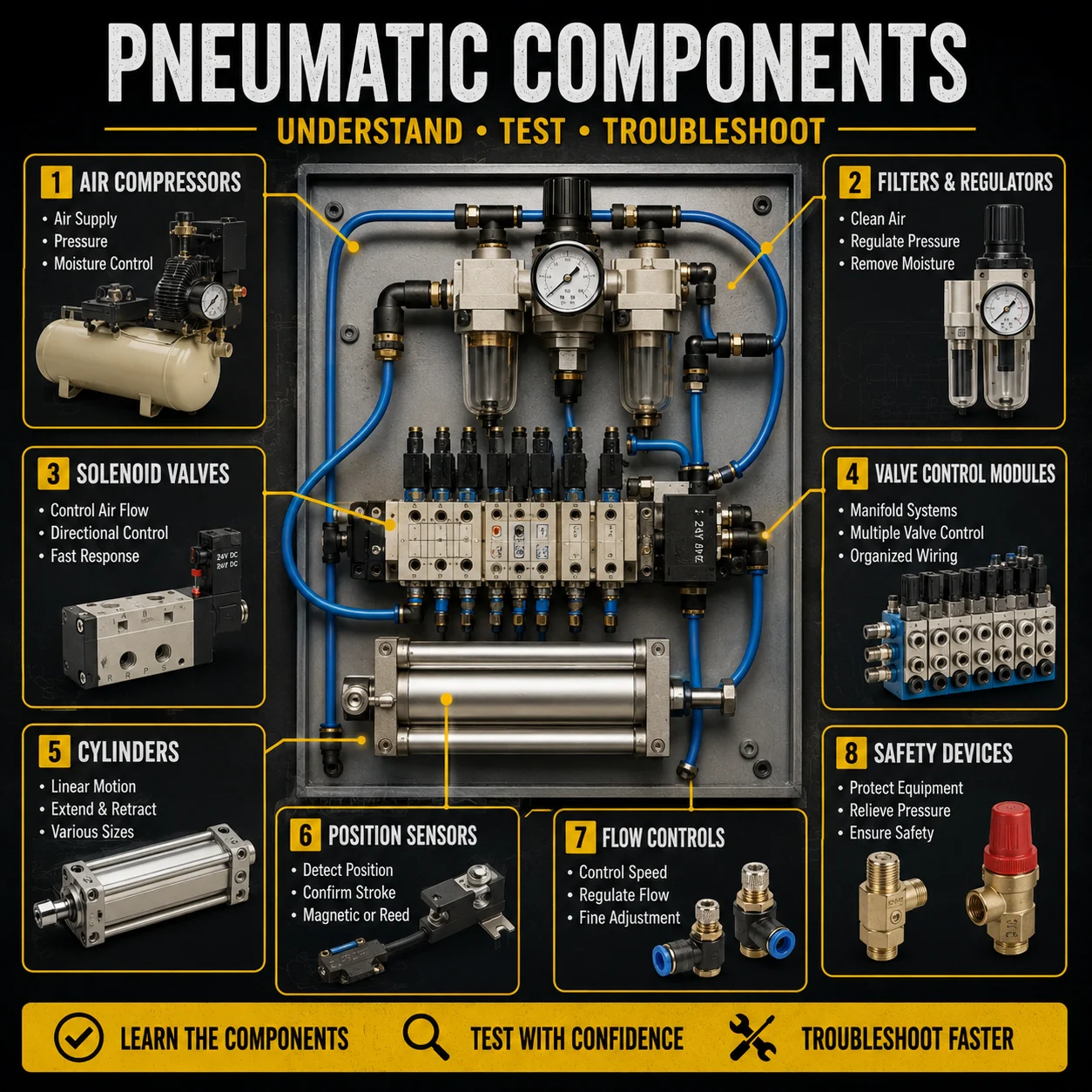
The same systematic approach applied to 10 pneumatic components. One framework. Both sides of the machine.
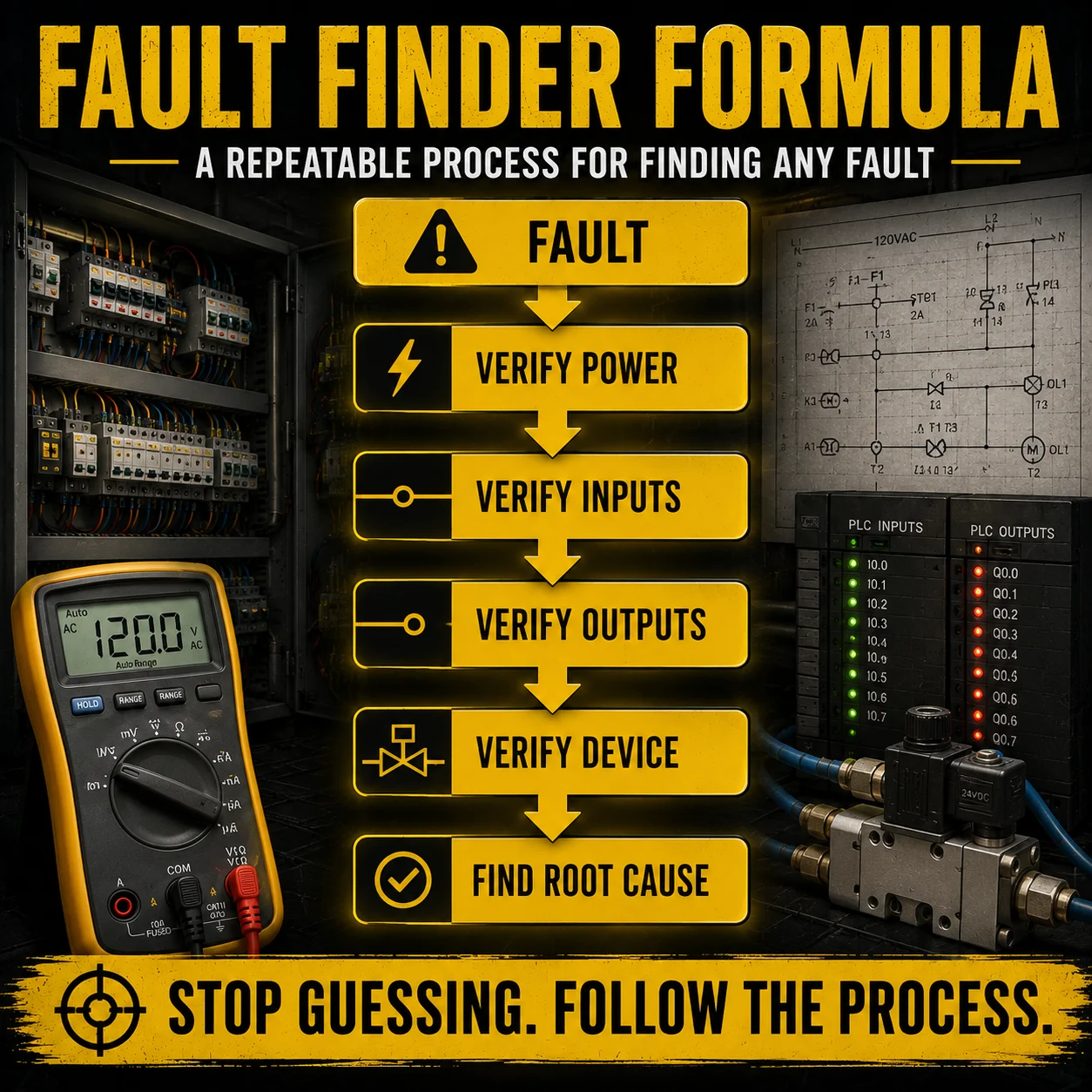
The repeatable, field-tested diagnostic process that ties all four pillars together. Rapid isolation techniques, root cause focus. Stop freezing under pressure — start working every problem with calm, clear logic, even when everyone's watching.
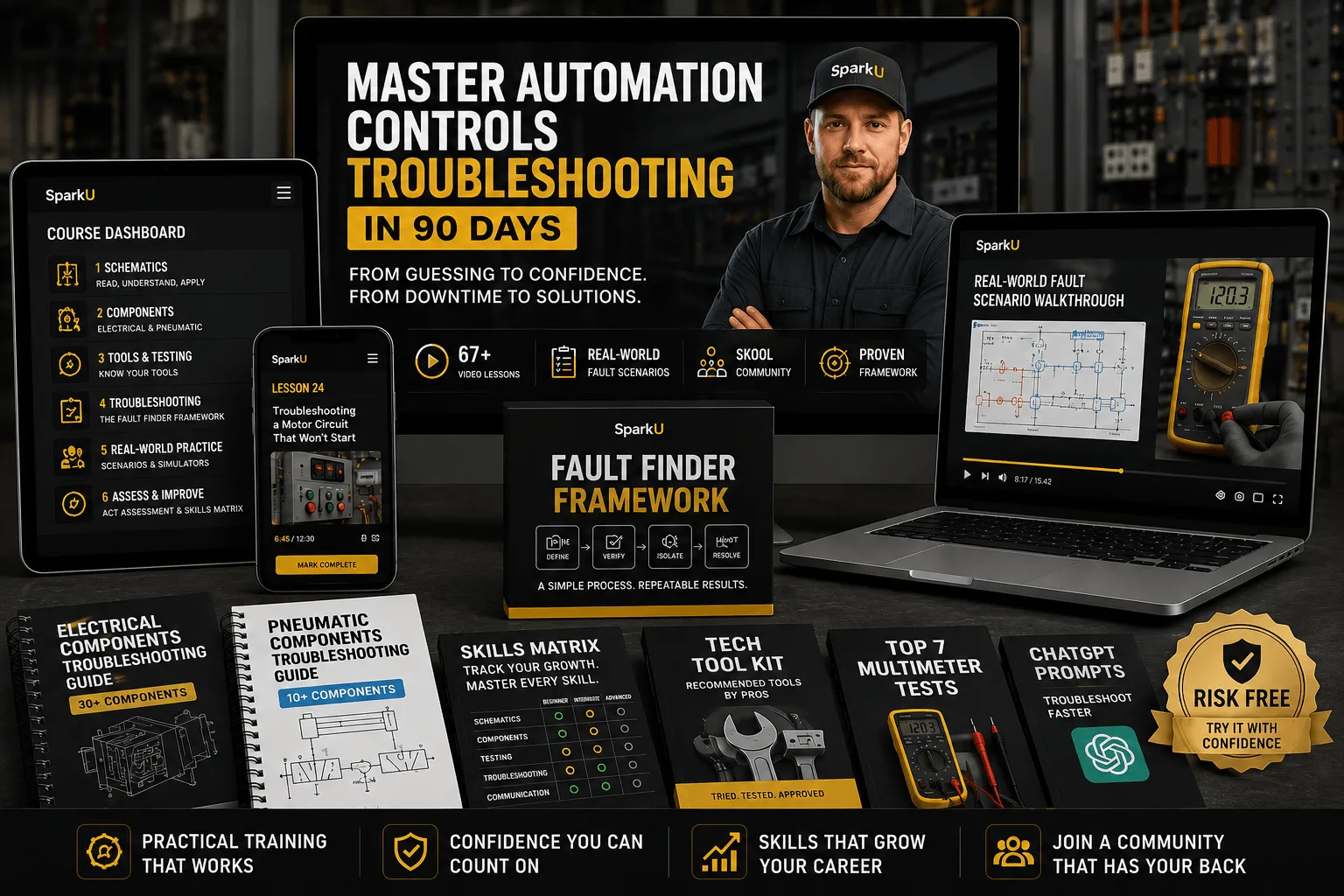
300+ gamified breakdown scenarios and questions you diagnose like you’re on the floor. Make your calls, get scored on your logic, and learn the right first move every time. Real reps that build diagnostic instinct — not just more to read.
Your personal library of 40+ diagnostic cheat sheets for electrical and pneumatic components — a quick-reference field guide you can print, keep, and use every day on the job. Clear steps, diagrams, and tests you can follow on the floor. No guessing, no wasted parts — every move backed by logic.
Your own custom-trained assistant built in ChatGPT — loaded with our troubleshooting logic and a built-in library of ready-made prompts to help you diagnose faults, ask better questions, and think through any problem. Requires ChatGPT Pro to use — instructions included.
Track your progress like a pro with this clear checklist of every skill you’ll need to master troubleshooting. Perfect for personal growth or for leads managing a team.
Based on real feedback from working techs — a complete list of tools you’ll want in your bag, from must-haves to time-savers. No fluff, no expensive overkill — just what actually gets used on the floor.
Get access to a private community of 700+ maintenance techs where you can ask questions, share wins, and get help from others on the same path.


If you're not ready to commit, the 30-day guarantee removes the risk. If you're ready to do the work, the 90-day guarantee backs the outcome.
Try the Fault Fixer Troubleshooting Course for 30 days. If it's not working for you — for any reason — you get your money back. No questions. No back-and-forth. No process.
Complete the course. Apply the process on the job. If after 90 days you're still not troubleshooting with more confidence — Jordon works with you one-on-one, one hour per week, for up to 12 weeks. Do the work. Get the result. See terms.
Most techs never need to ask, because the skill keeps paying off on the floor. But that's your call to make — not ours.
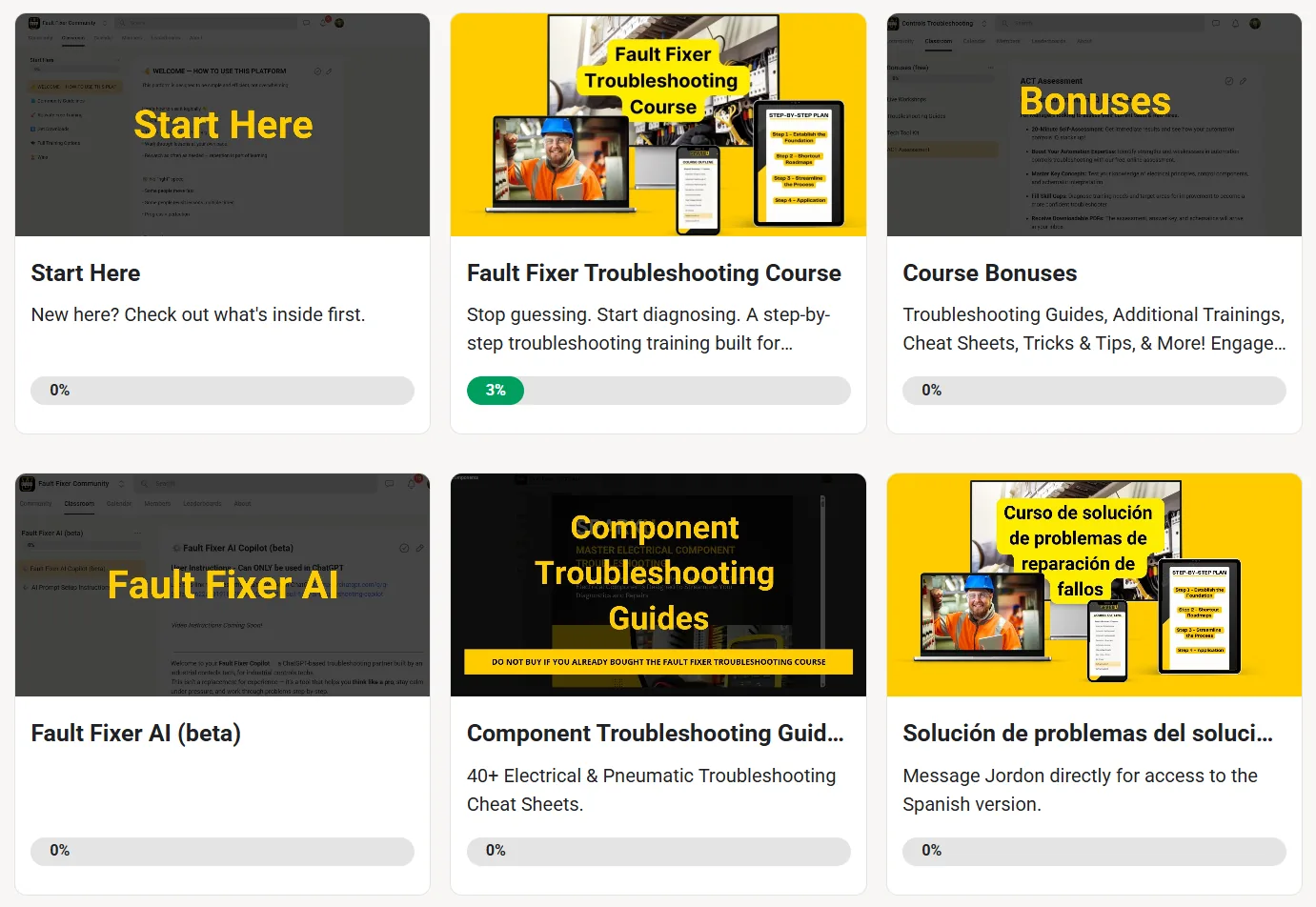
"I want to be the guy who just KNOWS things. Not the guy who has to Google everything. Give me the process. Give me something I can use tomorrow."

Founder, SparkU Solutions · USAF Veteran
Jordon came out of the Air Force and landed a role in industrial food processing equipment. He was hastily promoted to Technical Services Manager — before he felt ready — and walked straight into the same fire every new tech faces.
Two experienced service managers before him had been let go for the same reason: they couldn't troubleshoot customer control systems under pressure. Jordon was next in line.
What saved him wasn't years of experience. It was a mentor who sat down with a schematic, walked him through it once — and it clicked. Within six months, he was training maintenance teams himself.
What he realized: experienced techs struggle to teach not because they don't know enough — but because they've forgotten what it felt like to know nothing. They skip the steps that are now invisible to them.
So Jordon built the Fault Fixer Troubleshooting Course around the learning journey that actually worked — not his years of experience. The structured path from zero to confident that every new tech deserves but almost nobody gets.
$397 one-time, or 4 easy payments of $111. 30-day money-back guarantee.
Most training teaches what components do — not how to think like a troubleshooter. The Fault Fixer Troubleshooting Course teaches the actual process behind fixing faults in the real world.
Completing a course or passing a test doesn't guarantee mastery. Real expertise comes from applying what you learn in real situations — and that's exactly how this is built.
The course is 100% self-paced and built to fit around shift work. Go as fast or slow as you need. No deadlines, no cohort, no pressure.
You don't need to be smart — just trained in the right process. If you can follow a system, you can do this. That's the whole point of the Foundational Four Framework.
Controls logic is universal. Whether it's packaging, food processing, manufacturing, automation, or distribution — the process applies. The thinking process doesn't change because the machine does.
This isn't theory or lecture — it's field-based training with real faults, real schematics, and practical lessons built to stick. It was designed by someone who was thrown into maintenance without proper training and had to figure out what actually works.
We cover PLCs as part of the bigger troubleshooting picture — but this isn't a deep-dive PLC programming course.
The truth is, you can go a long way in troubleshooting without being a PLC expert. We'll show you how.
Go through the training. Apply the process on the job. If after 90 days you've completed the course and you're still not troubleshooting with more confidence — Jordon will work with you one-on-one, one hour per week, for up to 12 weeks, until it clicks.
To qualify, you need to have completed all course modules and made a genuine attempt to apply the method. Do the work. Get the result. See terms.
Yes. Complete the training and you'll receive a Fault Fixer Certificate of Completion you can share with your employer or add to your LinkedIn profile. Completion is currently self-reported.
Absolutely — and more companies cover this than you'd think. We provide a receipt for every payment you can submit to your employer or HR for reimbursement. Many techs get this fully covered. It never hurts to ask.
Email Jordon directly at jordon@sparku.solutions — he reads and responds to every message.
Most techs pause right before they bet on themselves. Hit play and hear the honest reason so many stay stuck for years, and why everyday techs become confident troubleshooters in under 90 days.
700+ techs who felt exactly where you are right now found the process. Every shift without it is another deposit in the shame account.