Industrial maintenance technician tracing a circuit on an electrical schematic
For Industrial Maintenance Techs in Manufacturing, Food & Beverage, Packaging, Automation and Distribution

Every Electrical Fault
Has A Path.
This Is How You Find It.

The techs who read any schematic cold have a process they don't even know they're following. We reverse-engineered it. This is it.

A step-by-step decode process for the industrial schematics you work with every day — from entry point to fault — in as little as 7 days.


Trusted by 700+ techs at these companies

Walmart Amazon Tesla Whirlpool Nestle Smithfield Del Monte Taylor Farms Walmart Amazon Tesla Whirlpool Nestle Smithfield Del Monte Taylor Farms
Is This For You?

Built For The Tech
Who's Ready To Finally
Close This Gap.

See if this sounds familiar:

This is for you if…
You've stared at a print for 20 minutes — followed it from pg. 4 to pg. 12 to pg. 7 — and you're now on pg. 7 with no idea why
You pick up the meter before you've actually read the drawing — because at least that feels like doing something
You hesitate — every time — at the same line on every lead tech posting: "read and interpret electrical schematics"
You'd rate yourself 9 out of 10 on anything mechanical — the schematic is where that number drops
You want to be the one they call when nobody can figure it out. Right now, on the electrical side, that's not you.
This is not for you if…
You can already open an unfamiliar schematic and read it with confidence
You need complete troubleshooting methodology — meters, component testing, fault-finding. This is schematic reading only.
You work in HVAC, residential, commercial, automotive, or marine electrical. This was built specifically for industrial manufacturing and production machinery.
Built For Industrial Production Equipment

If this is where you work, you're in the right place.

🏭
Manufacturing
🍔
Food & Beverage
📦
Packaging
🤖
Automation
🏪
Distribution & Warehousing
Why It Hasn't Clicked Yet

It's Not A Skill Problem.
It Was Always A Training Problem.

The gap is the same across thousands of technicians — the same hole in the foundation.

Here's what happened.

01

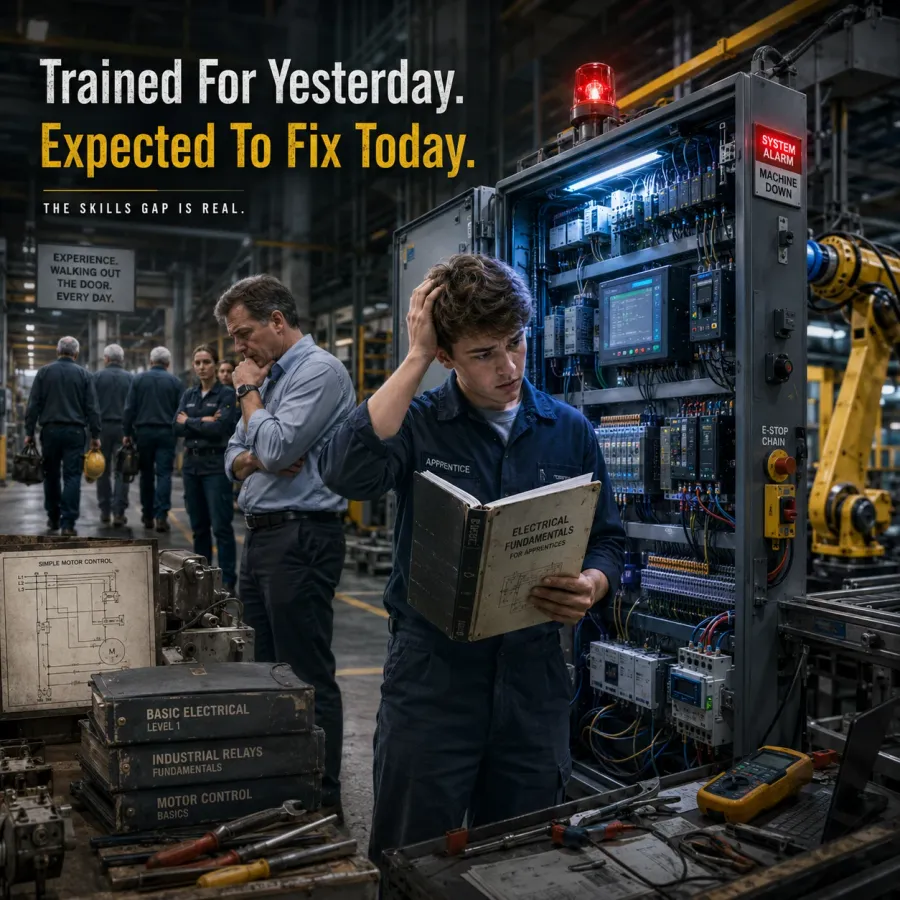
The Apprenticeship Taught Whatever Broke That Day

The apprenticeship taught whatever broke that day

Most apprenticeships aren't built around a learning sequence. They're built around production.

You learn whatever machine happens to be down. Over time you collect experience. What you don't always build is a framework for how the system fits together.

02

The Senior Tech Can't See The Steps Anymore

The senior tech can't see the steps anymore

The best schematic readers in the building have a process. Most of them don't realize they have one — the steps became automatic years ago.

You've watched him prove it. Thirty seconds. Machine back up. Walks away without a word.

That specific moment has its own kind of sting.

03

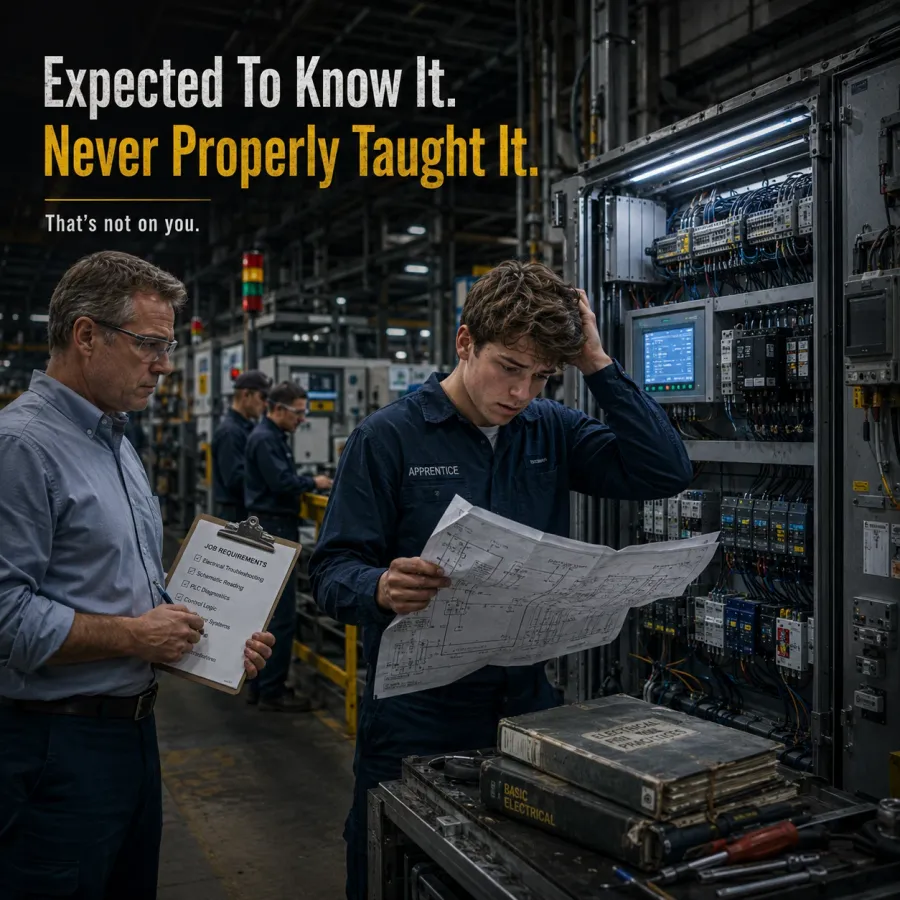
The Employer Expected It And Never Taught It

The employer expected it and never taught it

"Read and interpret electrical schematics." It's on every maintenance job description. Required on the floor, every shift.

You're being evaluated on a skill nobody here ever properly taught you.

That's not on you.

04

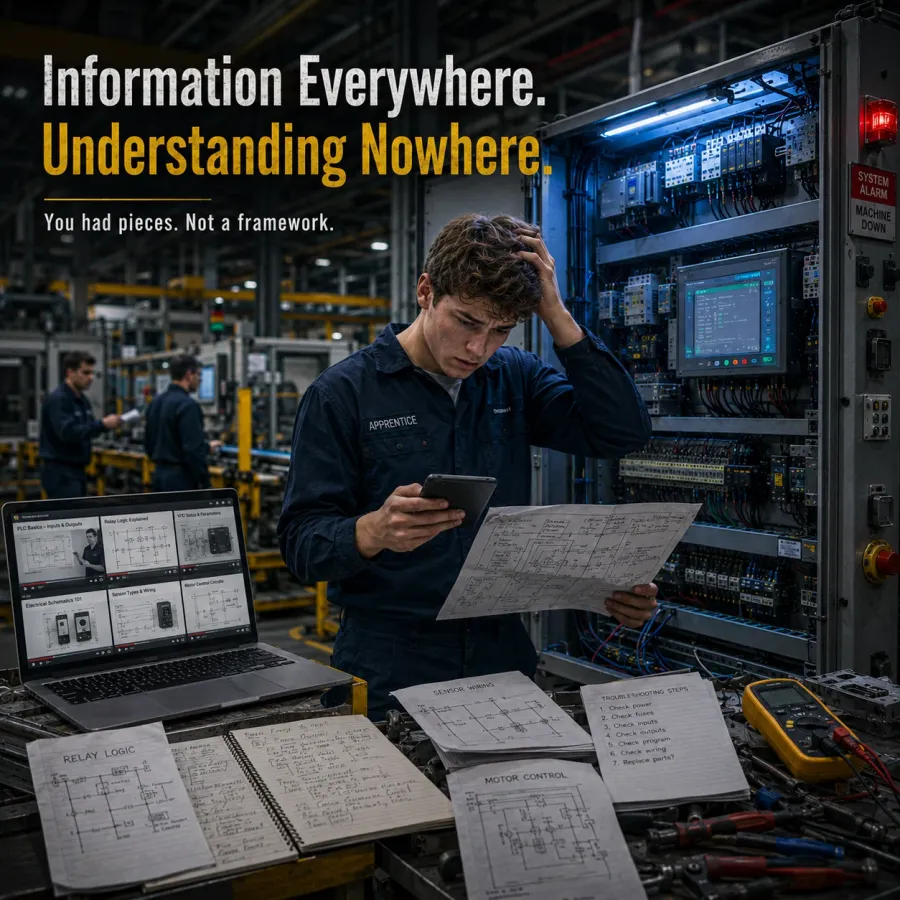
YouTube Gave You Information. Not Understanding.

YouTube gave you information, not understanding

The problem wasn't the information. The problem was the sequence.

You collected knowledge. What you never received was the framework that ties it all together.

Four different sources. The same missing piece.
Here's The Truth

The Gap Is Specific.
And So Is The Fix.

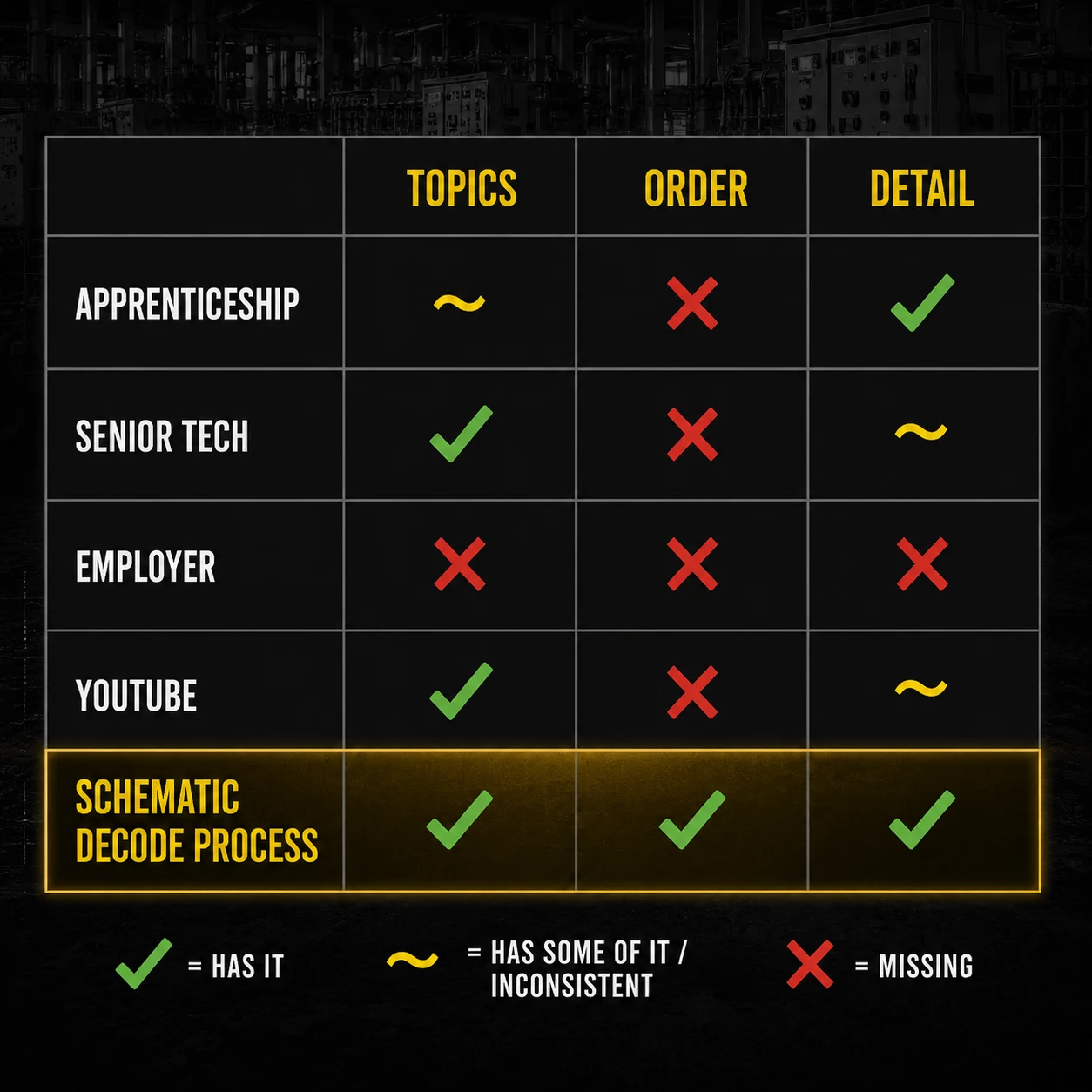
Every source below failed the same three ways — wrong topics, wrong order, or the wrong level of detail for the floor.

Comparison table — four sources (apprenticeship, senior tech, employer, YouTube) each failing the same three ways: wrong topics, wrong order, wrong level of detail.

But look at the order column. Every single one. That's not a coincidence.

Three different symptoms. One root cause.

The process — the specific, repeatable method for reading any industrial schematic as a complete system, built around the right topics, in the right sequence, at the right level of detail for the floor — was never part of any of it.

That's the whole gap.

That's not a talent issue. That's a training problem. And a training problem can be fixed.

The process exists. You just haven't been shown it yet.

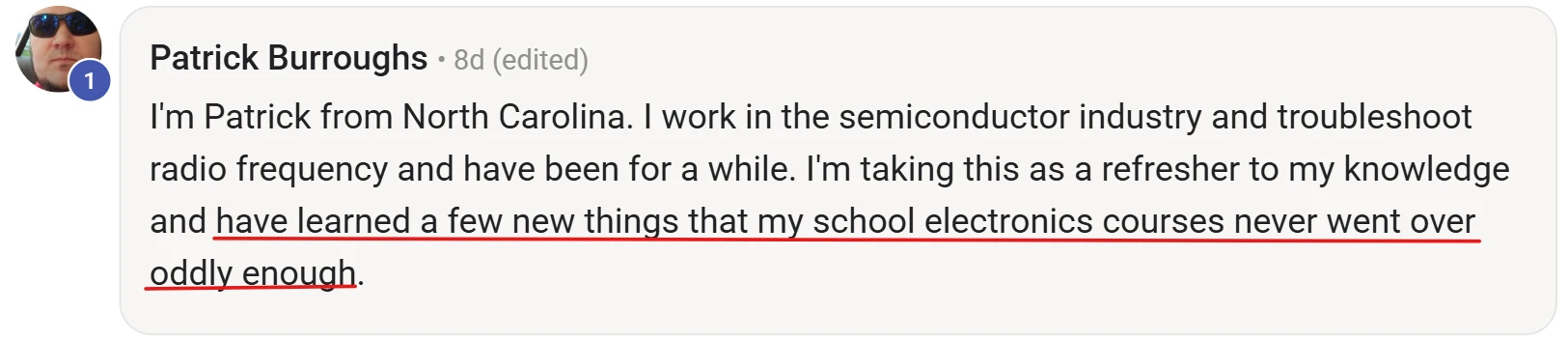
Patrick Burroughs testimonial — his school electronics courses never covered this, and he's been troubleshooting RF in the semiconductor industry for years.
This Will Help You

Finally Read Any Schematic
With Confidence.

Most senior techs who read schematics cold have no idea they have a process. It became automatic so long ago they can't see it anymore — which is exactly why they can't teach it.

But watch enough of them work and you'll notice something: they all follow almost the same sequence. Same way into the print. Same way through the references. Same logic for following the circuit to the fault.

That pattern is real. We reverse-engineered it. That's what our process teaches.

Schematic training outcome

Once that process is yours, here's what changes on the floor:

Walk up to any breakdown, pull out the print, and actually know what you're looking at — before you touch a single wire
Know what your meter should read before you touch a single test point — because the drawing already told you
When someone says "did you check the drawing?"you already have.
Open a schematic from a brand you've never seen before and recognize the structure immediately
Have the same capability as the best schematic reader on your floor — without spending years figuring it out the hard way.
Justin Seaborn — scored highest on written test, went from fired to dream job
How It Finally Starts Making Sense

Decode An
Electrical
Schematic.

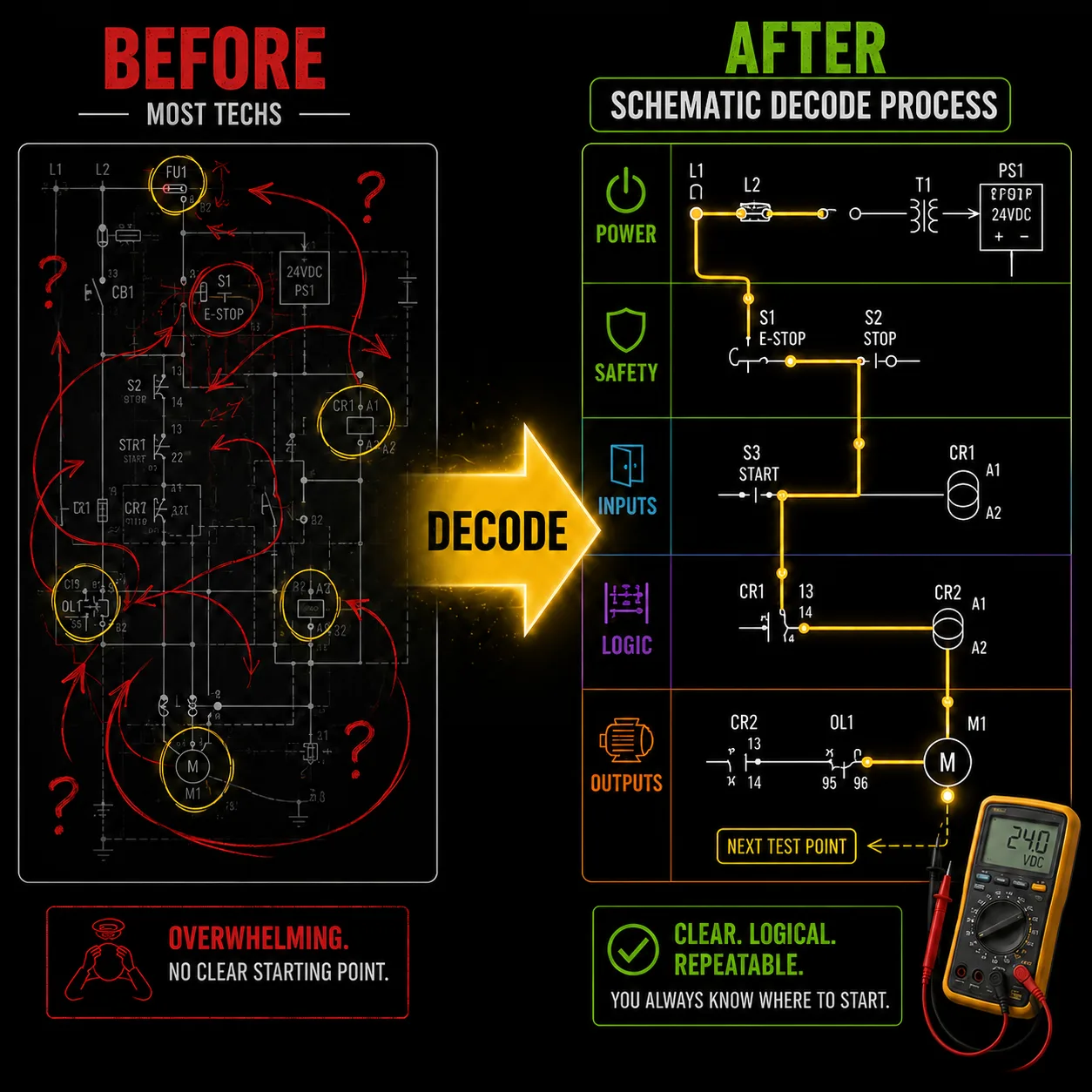
A clean electrical schematic with the circuit path traced through it

Before a schematic can help you… you have to know how to decode it.

That means:

  • Learning how to enter and navigate any schematic before reading a single circuit — project context, document structure, symbols recognized in context
  • Understanding the voltage structure and safety circuits that form the foundation every other section hangs on
  • Reading the complete machine in sequence — motor circuits, PLC inputs and outputs, and pneumatic systems — in the order they actually connect

Once you can do that… the schematic stops feeling overwhelming and starts becoming something you can actually read.

Start Reading Schematics With Confidence →

I Used To Think Every Schematic Was Different.
I Was Wrong.

Most people think schematics are hard because of the symbols. Or the numbers they can't place. Or because every manufacturer does it differently. Or because every new print feels like starting over from scratch.

Jordon Schultz

None of that is the real problem.

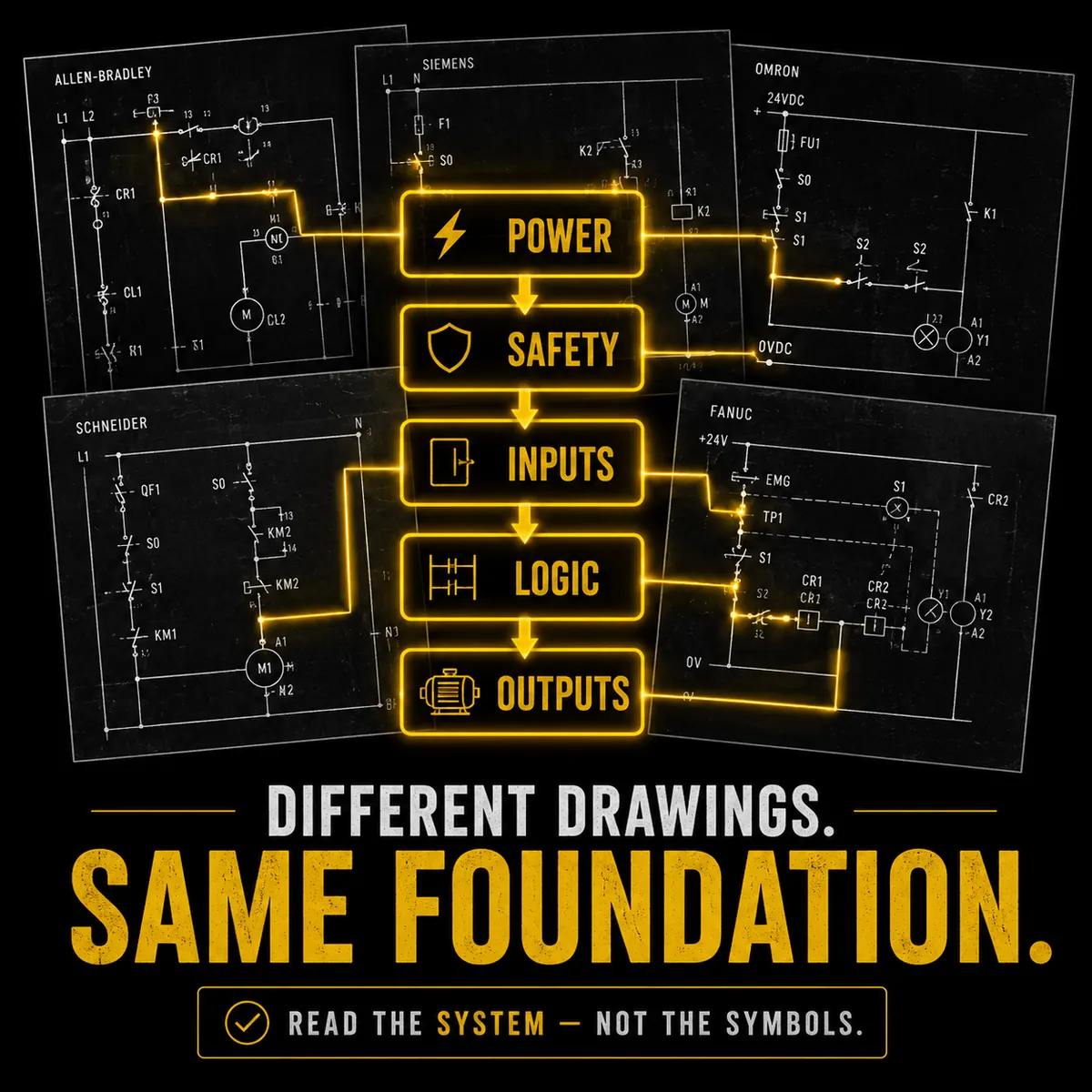
Once someone walked me through a few real schematics — not the symbols, the structure — I realized every industrial print is built on the same foundation. The manufacturer changes. The format changes. The underlying logic doesn't.

Different drawings. Same foundation.

Once you see it, you can't unsee it. You stop guessing what you're looking at and start reading the system.

Start Reading Schematics With Confidence →
Student Wins

Real Techs.
Real Results.

Student Win

"I figured it out — and people noticed."

Student win
Student win
Student Win

"The way it's presented makes schematics easier to grasp."

Student Win

"I can grab a schematic and know where to start now."

Student win
Student win
Student Win

"Having it explained made schematics feel way easier."

Student Win

Ben could now recognize schematic patterns that used to slow him down.

Student win
Here's How It Works

The Schematic
Decode Process.

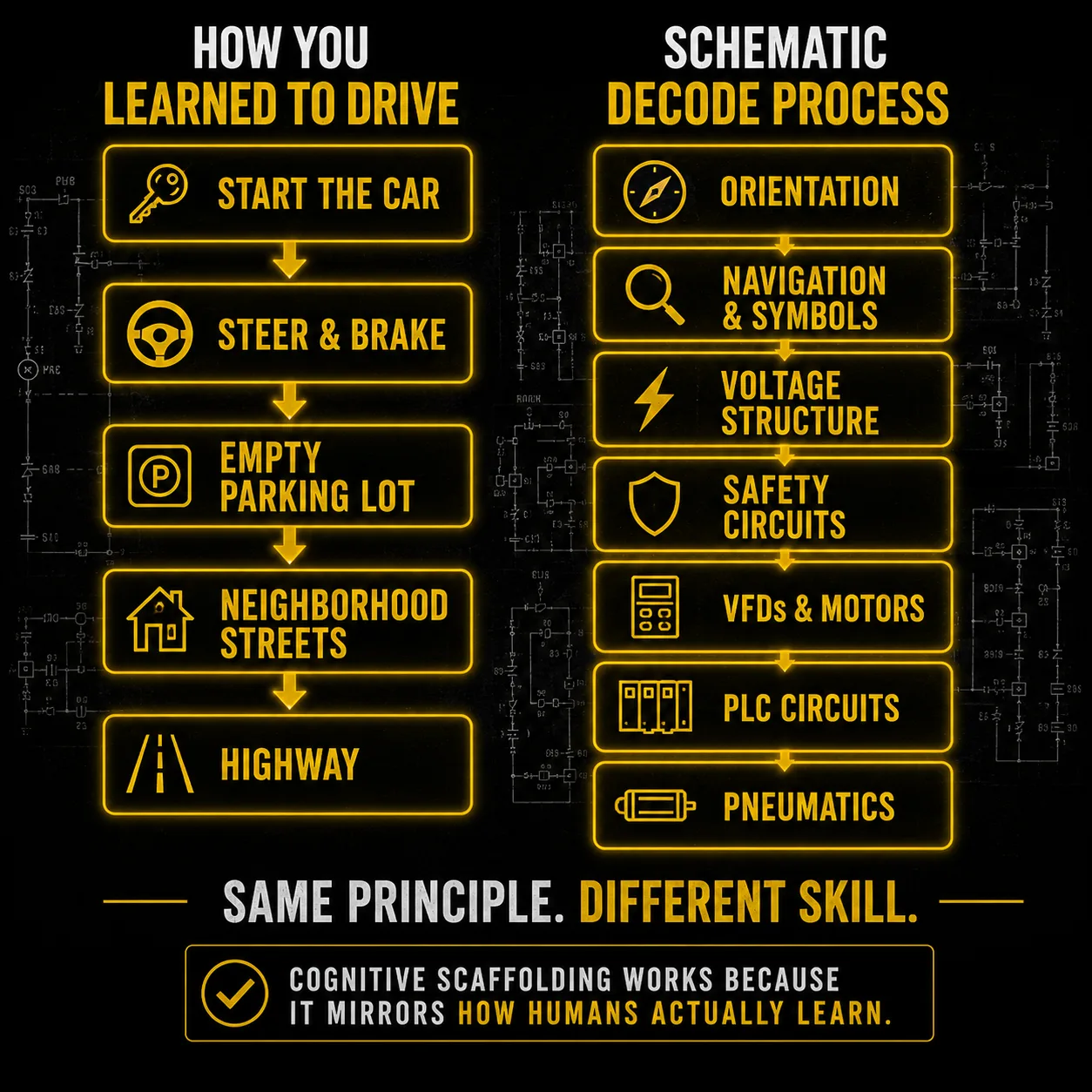
The Schematic Decode Process teaches schematic reading in the exact order understanding actually builds — finally made explicit and teachable. Each layer directly enables the next. That's not a coincidence. It's the point.

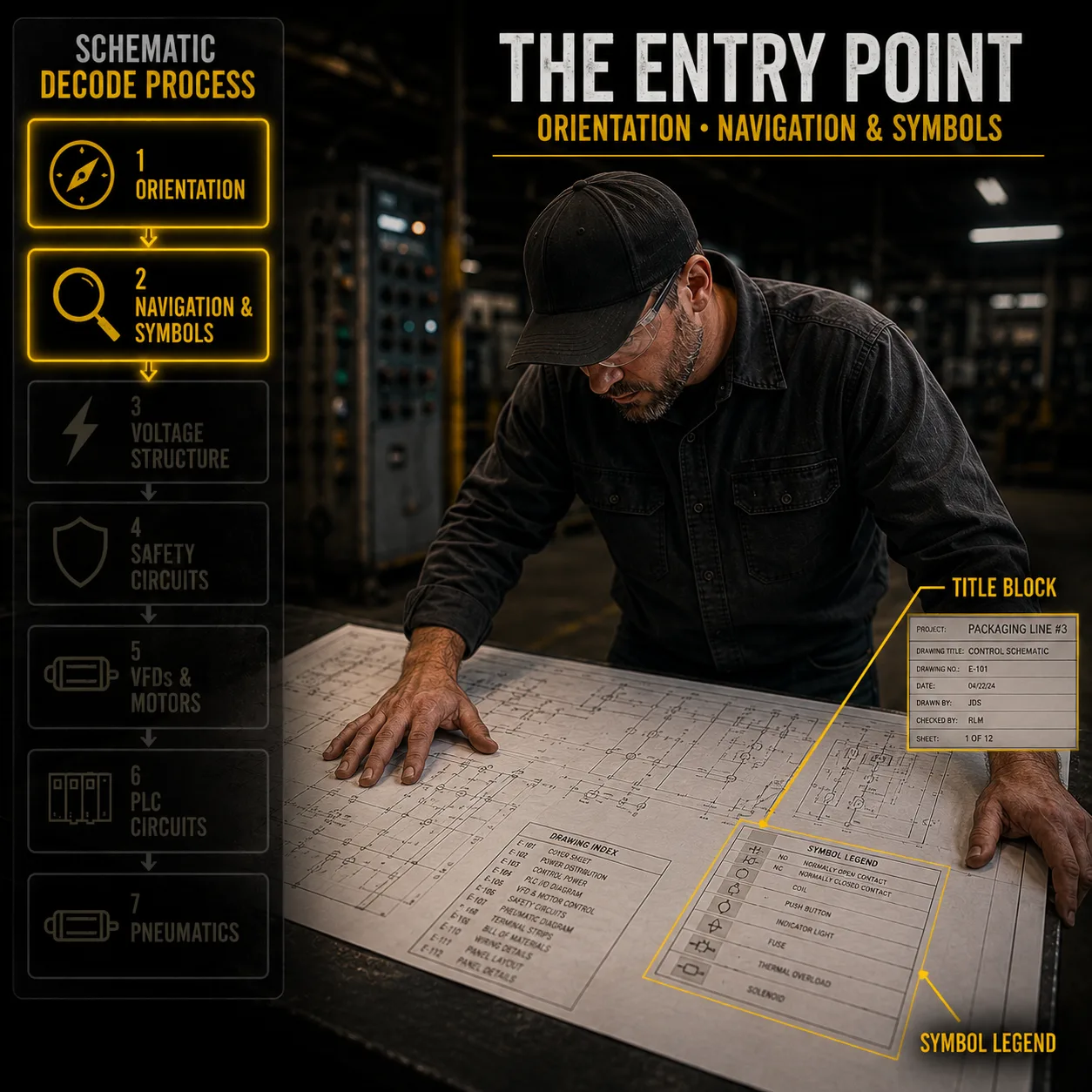
The Entry Point

Orientation, Navigation & Symbols

The Entry Point — orientation, navigation, and symbols

Before you read anything, you learn what you're actually looking at and how to move through it.

Project context. Document organization. Cross-references between pages. Symbols recognized in context — not memorized.

This is what the first 60 seconds looks like when someone who can read schematics opens an unfamiliar print. Most techs skip straight past it.

Which is exactly why every new print still feels like starting over.

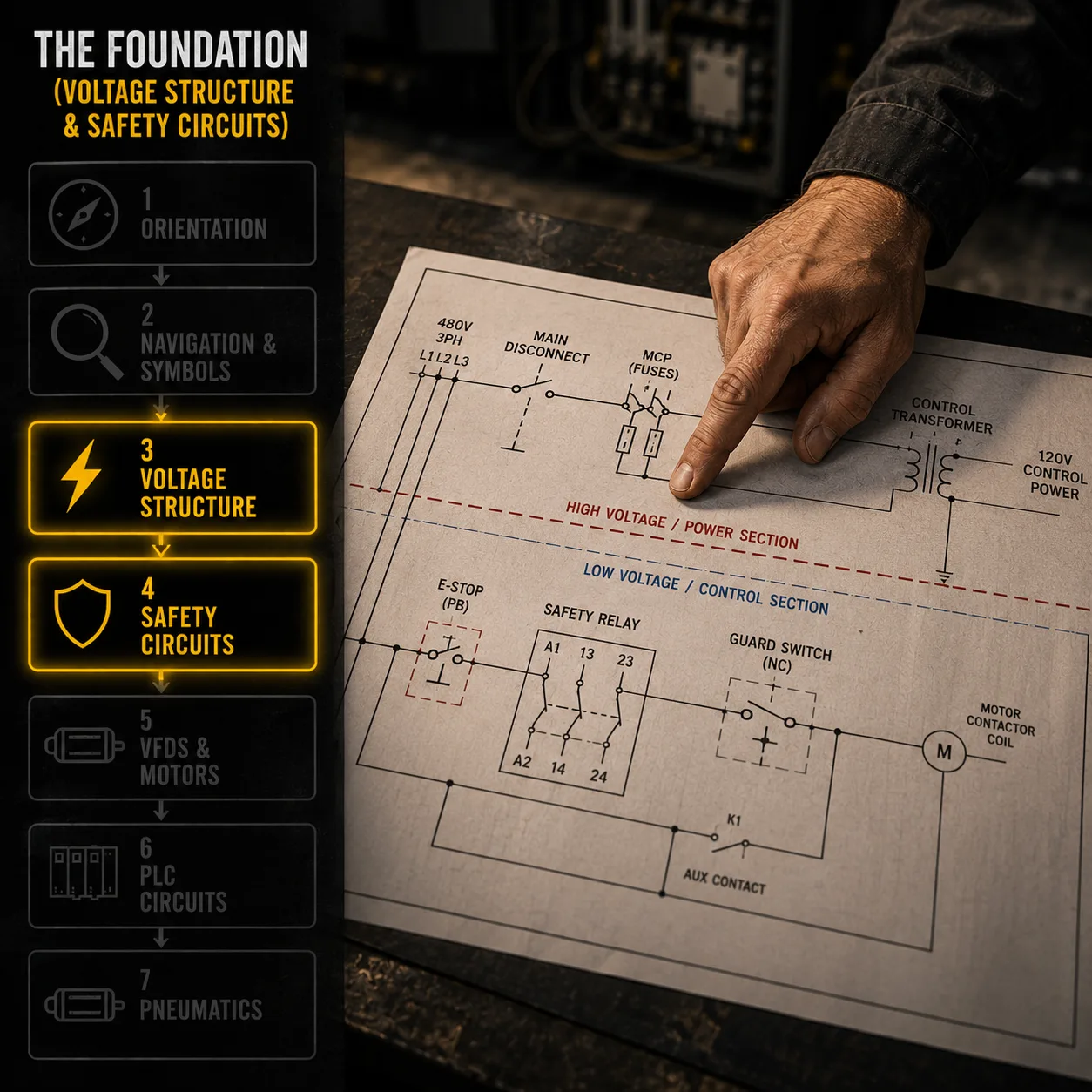
The Foundation

Voltage Structure & Safety Circuits

The Foundation — voltage structure and safety circuits

Industrial schematics are organized by distinct voltage classes and circuit functions, clearly separating power supply lines, neutral returns, safety grounds, and DC references.

Before you can read any specific circuit, you need to know which zone you're in and what that means.

Once that structure is clear, safety circuits become readable — and they matter more than any other section because they determine whether the machine can run at all.

This is the layer everything else hangs on.

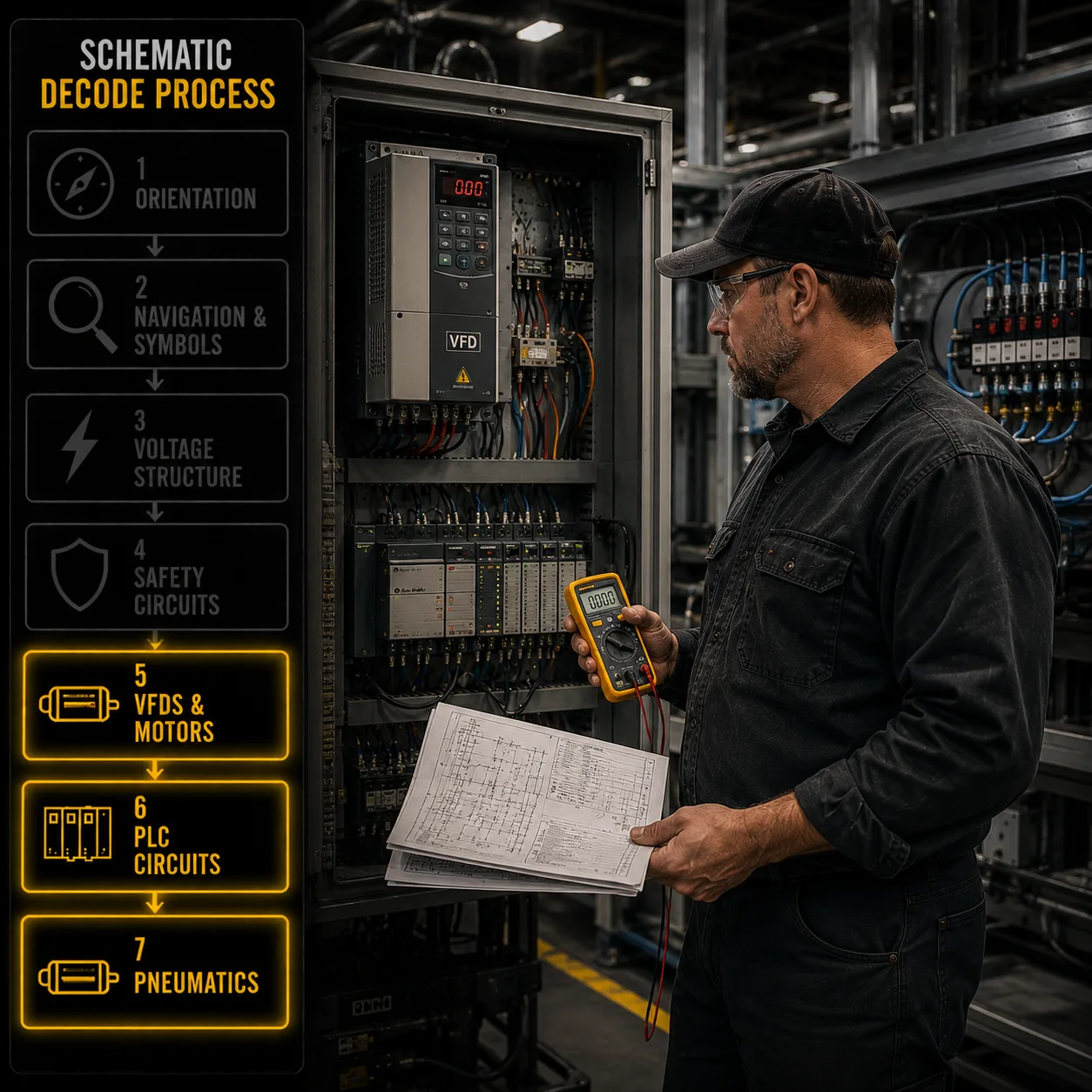
The Systems

Motor Controls, PLCs & Pneumatics

The Systems — motor controls, PLCs, and pneumatics

VFD and motor circuits bridge the power and control sections — reading them requires understanding both.

PLC inputs and outputs sit at the end of the decision chain. Every signal they receive comes from field devices wired into circuits you now understand.

Pneumatic systems are driven by those same electrical outputs. This final layer ties both sides together.

By this point you're not reading isolated sections of a schematic. You're reading the complete machine.

Why This Actually Works

Understanding Builds
In Sequence.

Throwing a football. Learning to fish. Driving a car. None of it started at the hard part — and none of it would have stuck if it did.

Reading electrical schematics is no different.

Cognitive scaffolding — understanding builds in sequence, each layer creating the mental foundation the next one needs

The technical term is Cognitive Scaffolding — a learning principle where complex tasks are broken into structured, sequential steps with support built in at every stage. The destination is always independence — the point where the steps are no longer consciously followed because they've become second nature.

Most schematic training gets at least one of the three requirements wrong: right topics, right order, right level of detail for the floor. The Schematic Decode Process gets all three right — each step creating the foundation the next one needs, and every lesson connecting back to reinforce what came before.

And if you already have pieces, this is what connects them. Most of it will feel familiar — but the sequence reveals gaps you didn't know were there. A few pieces you never knew were missing — those are the ones that make everything else finally click.

Here's Exactly What's Inside

Fault Fixer Schematics
Training.

Everything a maintenance tech needs to go from staring at a print to actually reading it.

The Schematic Decode Process ($149 value)
Step by step, in the order it actually clicks — on IEC European prints and NEMA/ANSI ladder diagrams — so a schematic stops feeling like a wall and starts feeling like a map with a logical path through it.
By the end, you'll be able to:
  • Navigate any multi-page schematic using cross-references, title blocks, and wire numbers — without losing your place between pages
  • Understand symbols in context — so an unfamiliar symbol doesn't stop your read mid-circuit
  • Differentiate between power and control circuits — and know which section you're in before you trace a single rung
  • Trace safety circuits from E-Stop to final output device — and identify exactly where the chain is breaking
  • Follow relay contact and coil logic through multiple rungs — trace why a sequence stopped and where
  • Read VFD wiring, motor protection, and contactor sequences — whether you're looking at an IEC print or a NEMA ladder diagram
  • Trace PLC input signals from field device to module and output signals from module to field device
  • Read pneumatic diagrams alongside the electrical schematic — so you can trace any fault that crosses both systems
  • Pick up a print you've never seen before and watch the process hold
Full Decode Walkthroughs ($97 value)
Start-to-finish decodes on real machines across different industries — no chapter breaks, no guided steps, every decision narrated in real time. Watching the process hold on a print you've never seen is what makes it yours.
Industries covered: 🏭 Manufacturing · 🍔 Food & Beverage · 📦 Packaging · 🤖 Automation · 🏪 Distribution & Warehousing
Plus These Added Bonuses
NEMA & IEC Schematic Symbol Reference (included)
Every common schematic symbol shown side-by-side in NEMA and IEC format — contacts, coils, motors, overloads, pushbuttons, switches, and more. Keep it open while you work through both series.
Schematic Reading Skills Card (included)
Every skill covered in the training laid out in one place — so you can see exactly what you're building, measure where you are, and recognize how far you've come.
Fault Fixer Community (included)
700+ industrial maintenance technicians on Skool
Certificate of Completion (included)
Lifetime Access & Updates (included)
Total Value $246
Your Price Today $67
One-time payment. Instant Access. Two Risk-Free Guarantees.
💻 100% Online
⏱️ Self-Paced
🎬 Step-by-Step Video Lessons
🌎 English & Spanish
♾️ Lifetime Access
🎓 Certificate of Completion
Start Reading Schematics With Confidence →

One-time payment. Instant Access. Two Risk-Free Guarantees.

Get Instant Access

Fault Fixer Schematics

$67
Reading schematics shows up on nearly every lead tech, controls, and senior maintenance job description. It's often what separates a $60K maintenance role from an $80K+ controls or lead position.
① Contact & Order
② Payment
Your Details
Add Meter Mastery for $17 (So You Don't Test the Wrong Thing)
The schematic finds the fault. The meter confirms it.
Measure voltage, test continuity, use a clamp meter correctly — and know when a reading is accurate versus when it's lying to you.
Grab the deal with quick click!
$17.00
Order Summary
Fault Fixer Schematics (Blueprint Bootcamp) $67
Total today
$67
$246 $67 TODAY
(Save $179 Today)
Two Risk-Free Guarantees | Protected Either Way
The Fault Fixer Guarantee — two risk-free guarantees, protected either way
Money-Back: Not helpful on the floor? Full refund, no questions asked.
Mastery Promise: Do the work and still stuck? We coach you one-on-one until it clicks.
🔒 100% Secure Site SSL Encrypted Checkout
Accepted payment methods: Visa, Mastercard, American Express, Discover, Apple Pay, Google Pay, Cash App
Protected Either Way

Two Guarantees.
Zero Excuses Not To Try.

If you're not ready to commit, the 30-day money-back guarantee removes the risk. If you're ready to do the work, the Mastery Promise backs the outcome.

30-Day Money-Back Guarantee seal
Money-Back Guarantee

Try Fault Fixer Schematics for 30 days. If it's not working for you — for any reasonyou get your money back. No questions. No back-and-forth. No process.

Mastery Promise — we coach you one-on-one until it clicks seal
Mastery Promise

Go through the material and apply the decode process on the job. If after 30 days you're still not reading schematics with more confidence — We work with you one-on-one, one hour per week, for up to 4 weeks. Do the work. Get the result. See terms.

For members who complete the training and apply it

$67.
Lifetime Access.

Most maintenance techs will stop mid-breakdown to browse the Snap-on truck. $300, $400, $600 — poof, gone before lunch. Tools are easy to justify. Nobody questions tools.

But the training that will actually move the needle in your career? Somehow that's the harder sell.

Here's the truth nobody says out loud — a $300 meter pointed at the wrong wire finds nothing. The same meter, guided by a schematic you actually understand, finds the fault every time.

That's the difference between a tool and the knowledge behind it.

Start Reading Schematics With Confidence →

One-time payment. Instant Access. Two Risk-Free Guarantees.

Jordon Schultz
Jordon Schultz

Founder, SparkU Solutions · USAF Veteran

Built By Someone Who Was Thrown In Too

He Didn't Grow Up
Knowing This Either.

Jordon came out of the Air Force and landed a role in industrial food processing equipment. He was hastily promoted to Technical Services Manager — before he felt ready — and walked straight into the same fire every new tech faces.

Two experienced service managers before him had been let go for the same reason: they couldn't read customer control system schematics under pressure. Jordon was next in line.

What saved him wasn't years of experience. It was a mentor who sat down with a schematic and walked him through the structure — not the symbols, the logic. How it was organized. Where to enter it. What to follow and in what order.

It clicked immediately. Different machines. Different manufacturers. Same underlying foundation. Every time.

Within months he was the one walking other techs through prints. Not because he got smarter — because he finally had the process.

So he built this training course around the learning journey that actually worked — not his years of experience. The structured path from confusion to confidence that every maintenance tech deserves but almost nobody gets.

"For the tech who's been grinding for years and still hits walls — the process was always the missing piece. Not the effort. Not the intelligence. The process."
What Others Are Saying

Real Techs.
Real Results.

Videos below are just 60 seconds each — must watch.

Play video

"The new guys crushing it — that's how they were trained, go talk to Jordon"

"You explained it and now I feel stupid for not understanding it the first time."

Michael Gonzalez

Play video

"The confidence would be invaluable."

"I wish I had this training when I first got into maintenance."

Patrick Stansell

Play video

"If I could do it, anybody could do it."

"I didn't even know where to start with an electrical problem."

Dusty Alsbrooks

Edward White — appreciates Jordon's wealth of knowledge and teaching methods that reach all levels of the industry
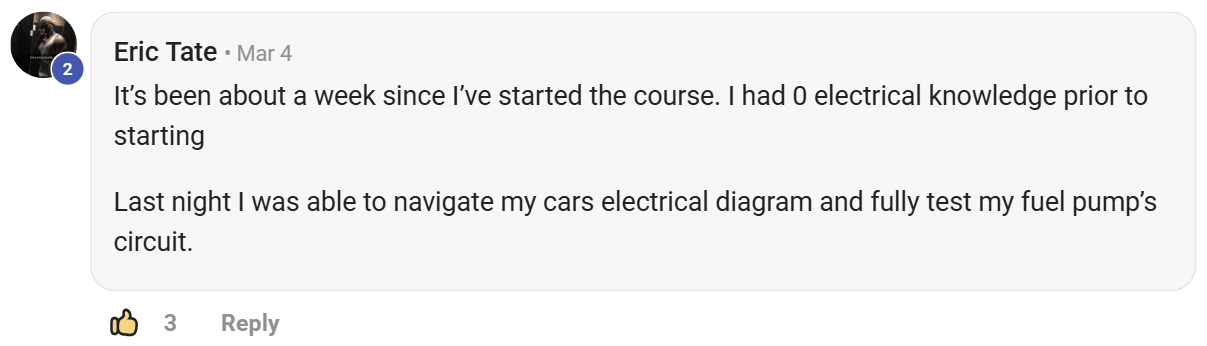
Eric Tate — went from zero electrical knowledge to navigating his car's wiring diagram and testing the fuel pump circuit in a week
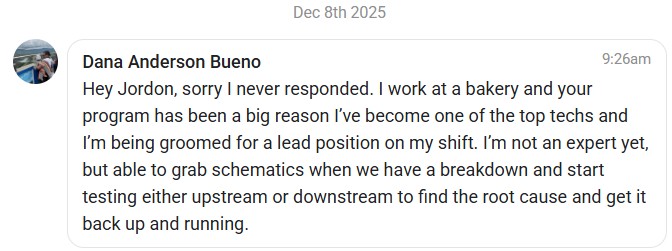
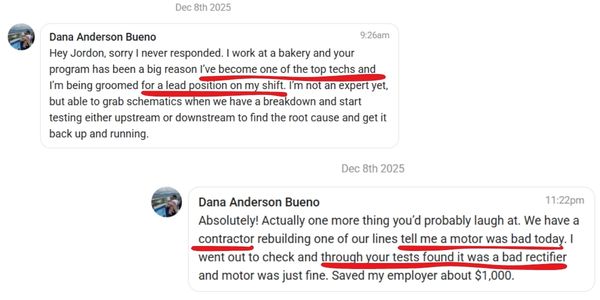
Dana Anderson Bueno — became top tech, groomed for lead position, saved employer $1,000
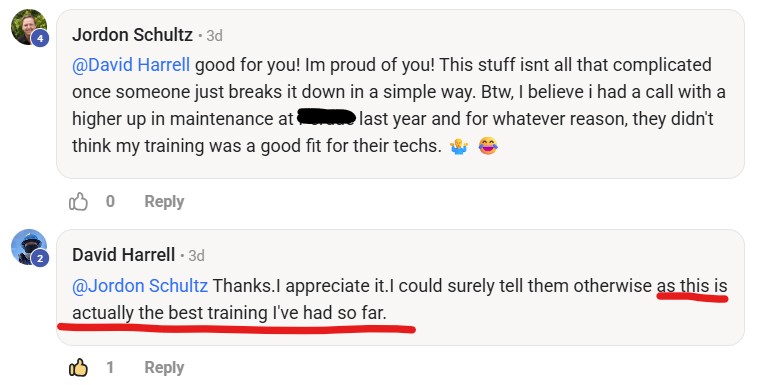
David Harrell — best training I've had so far
Bill Hardison — better than local college classes, recommending to coworkers
Eric Schultz — better than local college classes, totally worth the investment
Patrick Stansell — the way you step through the process makes logical sense
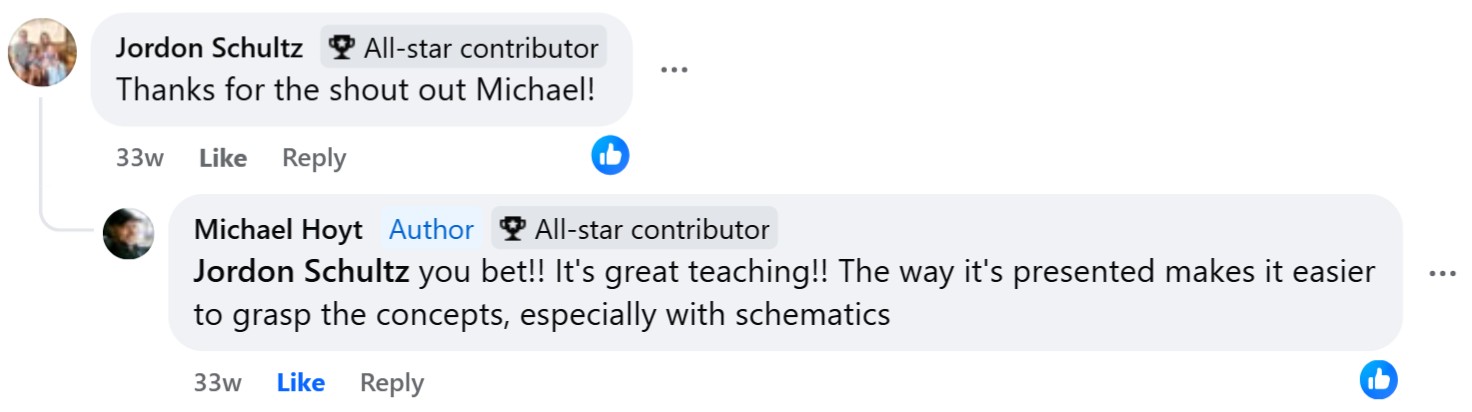
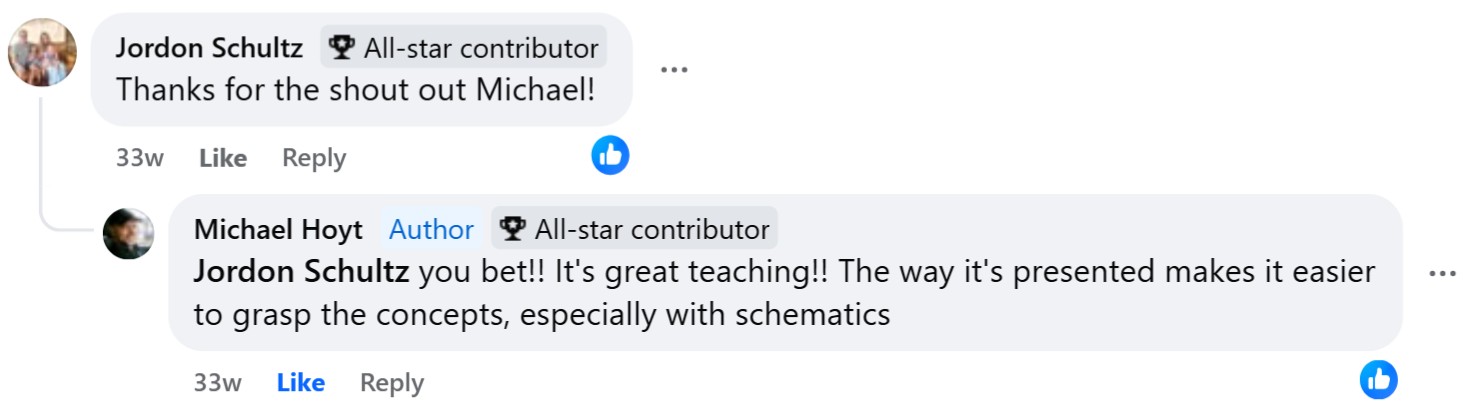
Michael Hoyt — great teaching, easier to grasp the concepts with schematics
Jeremy Price — highly recommend, straight forward no BS learning program
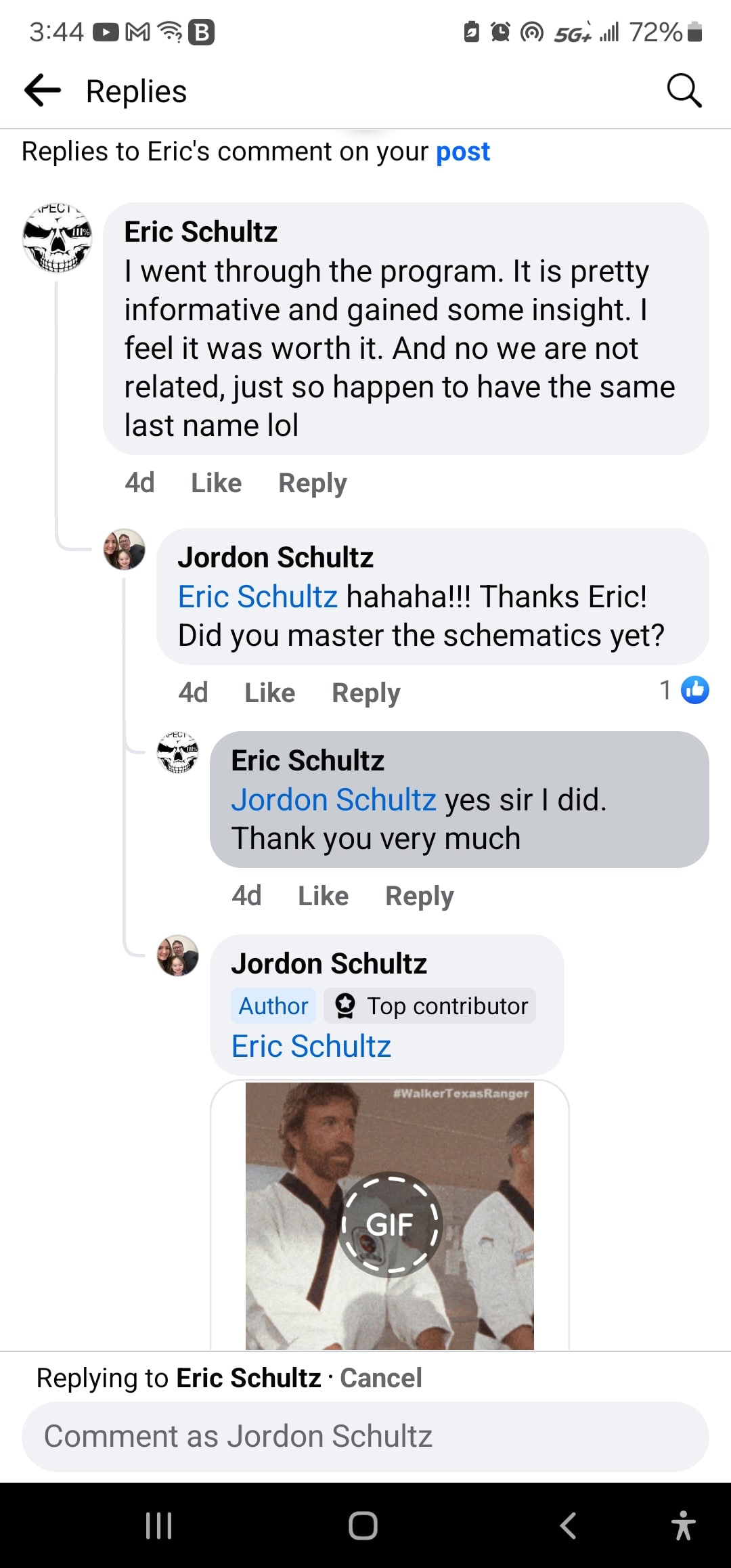
Eric Schultz — went through the program, mastered schematics, worth it
Barry Homfeld — 5 stars: great course, informative and practical
Beau McDaniel — troubleshooting skills increased learning from Jordon
Ukeme Samuel — 4 stars: definitely learning new things
Stanislav Lipatov — 5-star Skool community review
Ishmael Mawutor Kumaku — 5-star Skool community review
Mihhail Kuznetsov — 4-star Skool community review
Jerry Ewing — 4-star Skool community review
Joe E — Skool community review
Common Questions

Straight Answers.

Yes. The training focuses primarily on European IEC drawings, with USA (ANSI/NEMA) coverage coming soon — but the method isn't tied to any one standard. You're learning how a circuit is structured and how to follow its logic, not memorizing a single manufacturer's symbol set.

That's the whole point. NEMA, IEC, or a European OEM that draws 80% to standard and 20% their own way — the decode process doesn't change. Once you can read the structure of a print, the standard in front of you stops being the problem. It's exactly why this holds up in packaging and food & beverage plants full of imported equipment.

You get instant digital access immediately after purchase. The training is currently hosted on Skool — everything is delivered online, so you can watch anytime, at your own pace.

No. This is the schematics module — pulled from the full system so you can start with the most important foundational skill first. The full course is available as an upgrade.

Yes. This is designed for techs who feel stuck or unsure when opening prints — not engineers or advanced programmers.

No. This is a structured, step-by-step walkthrough that shows you where to start and what to follow — something random videos don't teach. YouTube gives you isolated answers. This gives you a repeatable process.

Two-part guarantee. First — if the training isn't for you, request a full refund within 30 days. No questions asked. Second — if you complete all modules and after 30 days you're still not reading schematics with confidence, Jordon will work with you one-on-one, one hour per week, for up to 4 weeks. Do the work. Get the result.

Yes. Complete the training and you'll receive a Fault Fixer Certificate of Completion you can share with your employer or add to your LinkedIn profile.

The Fastest Way To Stop Guessing

Stop Guessing.
Start With
The Prints.

If you can read electrical schematics, you're already ahead of 90% of technicians on the floor. Join 700+ techs who've gone from part-swappers to problem solvers.

$67
one-time payment
Instant access · Lifetime · Two risk-free guarantees